
Lululemon’s AI performance marketing strategy


Lululemon has long been a front-runner in activewear, known for its innovative,
performance-driven apparel and community-focused go-to-market strategies. Yet, even the
strongest brands need to adapt to macro shifts like
changing consumer behaviors, rising customer acquisition costs, and fierce competition.
Last year, Lululemon’s performance marketing team faced high-revenue growth goals amid
macroeconomic uncertainty. They needed transformative impact and used AI-powered
solutions to deliver it.
Business goals
From the outset, the team had three clear goals: drive sales, acquire new customers
efficiently, and maximize return on ad spend. They set up three priority workstreams,
each mapped to a goal: restructuring and optimizing their shopping campaigns; building a
new customer acquisition engine; and strengthening their measurement foundations. Here,
we dive deep into how the brand implemented each of these priorities — and the
impressive results.
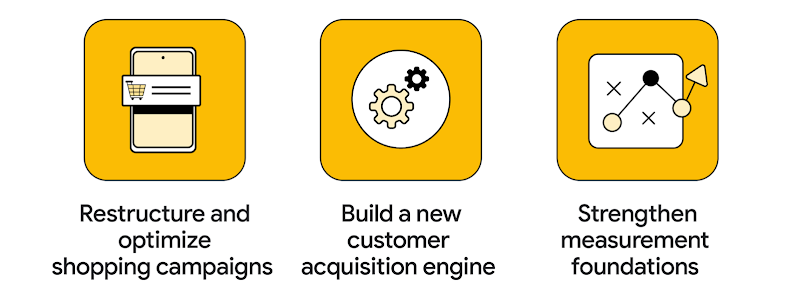
1. Restructure and optimize shopping campaigns
The team began by completely overhauling the structure of their shopping campaigns. This
critical step allowed Lululemon to fully utilize
Performance Max, which uses AI to optimize and distribute ads across Google channels — like Search and
YouTube — from one campaign. It also involved a mindset shift toward gaining brand
efficiency while accepting a lower return on ad spend (ROAS) for new customers
unfamiliar with Lululemon.
Taking this approach allowed the team to implement more strategic bidding and
personalized ads as well. Shopping ads were tailored to different customer segments,
with distinct approaches for new, undecided, and returning customers. This precision
ensured the right message reached the right people at the right time, maximizing
engagement and conversions.
2. Build a new customer acquisition engine
Next, using Performance Max, Lululemon created an engine designed to acquire new
customers. It operated as a real-time data pipeline to new customer information. This
data provided the insights needed to optimize its campaigns more effectively.
From there, the team launched three dedicated Performance Max campaigns designed to
attract new customers, using
customer lifecycle goals
to improve efficiency. The success of this data-backed approach justified allocating
more budget to acquiring new customers, without negatively impacting campaigns geared to
existing customers.
Buoyed by success in Canada, the team exported their strategy internationally to
reach even more customers.
3. Strengthen measurement foundations
Finally, to further strengthen its AI-driven approach, Lululemon implemented a
“measurement trifecta” by blending
marketing mix modeling (MMM), experiments, and attribution to gain a more holistic view of performance. MMMs
revealed how different marketing activities influenced sales over time; experiments
allowed the team to test and refine their strategies; and attribution helped them
pinpoint the most effective touchpoints in the customer journey.
Next-level gains in customer acquisition, revenue, and ROAS
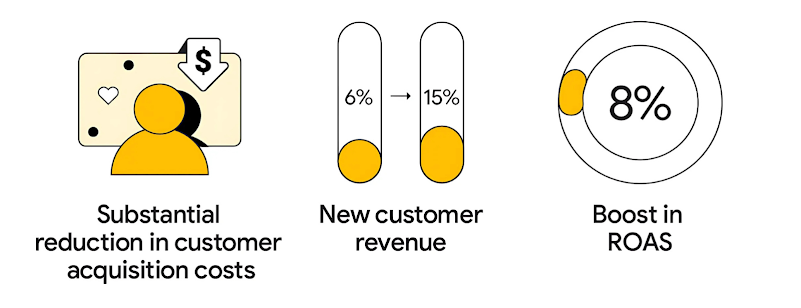
Lululemon’s results were game changing for the business and
earned top honors
at the Google Search Honours Awards in Canada last fall. The approach drove a
substantial reduction in customer acquisition costs on
brand excluded Performance Max campaigns
in Canada, increased the percentage of new customer revenue (from 6% to 15%), and
boosted ROAS by 8%. Buoyed by success in Canada, the team exported their strategy
internationally to reach even more customers.
By implementing AI across its performance marketing, Lululemon shows the transformative
power of AI tools and a forward-thinking mindset.
link