
Penny shortages causing big legal, business headaches in much of US
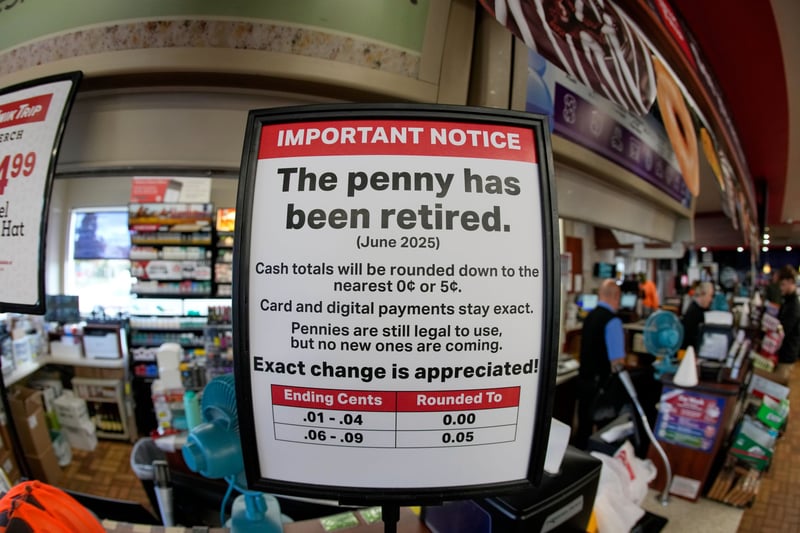
(CN) — The government’s phasing out of the penny without providing any legal guidance on how to handle the transition is causing big headaches for retailers and could result in large corporate losses, class action litigation, banking problems and trouble for businesses that accept SNAP payments.
President Donald Trump announced on Feb. 9 that the U.S. Mint would cease producing pennies, which cost about 3.7 cents each to make. But unlike Canada, Australia and other countries that have eliminated their one-cent coins, the U.S. government offered no rules or explanations for how transactions should be handled going forward, creating a chaotic situation and a legal quagmire.
“They just said ‘Let’s get rid of it’ and moved on, but they’ve created a train wreck,” said Bill Maurer, director of the University of California, Irvine’s Institute for Money, Technology and Financial Inclusion.
The last circulating pennies were minted in June, although the Mint made news by striking a ceremonial “last penny” on Nov. 12. America still has about 250 billion one-cent coins in circulation, but the Federal Reserve is shutting down its mechanisms for distributing the coins to banks, resulting in severe shortages for merchants in some parts of the country.
The Fed has 165 locations that handle distribution of currency to financial institutions, and some 109 of them have now ceased distributing pennies. “There’s been no announcement as to why,” Maurer said. “This was done without any planning or forethought as to what would happen and how it would cascade through the economy.”
Where the coins are in short supply, many retailers are now rounding cash transactions up or down to the nearest nickel. But the problem is that many jurisdictions have laws saying that cash customers can’t be treated worse than credit card customers — which means that some retailers are always rounding down rather than up to avoid massive class actions.
Kwik Trip, a large convenience store chain, says rounding down is expected to reduce its profits by $3 million a year.
“Cash discrimination” laws exist in Delaware, Connecticut, Michigan and Oregon, as well as New York City, Philadelphia, San Francisco, Miami, Seattle and Washington, D.C.
New York City’s law provides for civil penalties as high as $5,000 per violation, which would be ruinous for any business that rounds up.
Even without specific legislation, almost all jurisdictions have consumer protection laws that prohibit deceptive sales practices — and advertising one price and charging a higher price at the register could run afoul of these laws, said Chris Phillips, a financial services partner at Holland & Knight in Austin, Texas.
Many consumer protection laws provide for double or triple damages plus attorney fees, giving lawyers an incentive to sue over small amounts. “The payments to the class are small, but the payments to the lawyers are not,” Phillips said.
The situation is dire for convenience stores, and “we desperately need legislation” to fix the problem, complained Jeff Lenard, vice president of the National Association of Convenience Stores.
Nationwide, convenience stores handle about 62.5 million cash transactions a day, with an average of two pennies in change.
Losing two cents on every transaction would cost the industry roughly $1.25 million every day, Lenard said.
And convenience stores often operate on very thin margins, often making a profit of only one cent on in-store transactions.
“The added cost of rounding down would make the average in-store transaction a money loser for cash transactions,” Lenard said. “Instead of making 1 cent per transaction, stores would lose 1 cent on every cash transaction.”
And because convenience stores have an average sale of only about $8, compared to about $100 for grocery stores, “the loss of 2 cents is a much larger percentage of sales,” he noted.
Stores could theoretically refuse to accept cash, but the jurisdictions with cash discrimination laws require retailers to accept cash, and credit card payments typically require merchant fees that would eat up any savings.
Throughout the retail industry, businesses are also being forced to pay out-of-pocket for “point-of-sale system updates, employee training and consumer-awareness efforts,” noted Dylan Jeon, the National Retail Federation’s senior director of government relations.
Some convenience stores have been offering free merchandise or gift cards to customers who bring in a lot of pennies and exchange them for dollars. Others are asking customers to donate the pennies they would otherwise receive to charity, then bundling the charitable contributions.
Banks are also facing problems because, when they cash checks and don’t have pennies, they always have to round up to avoid illegally shortchanging customers. And businesses that pay wages in cash likely have to always round up to comply with state wage laws.
The SNAP program is especially difficult because federal laws say that SNAP customers can’t be treated “differently” from cash and credit customers — but if stores are charging credit customers full price but rounding down for cash customers, there’s no way to avoid treating SNAP customers differently from one group or the other.
“There’s no way to square that circle,” Phillips said.
Some stores are deciding that SNAP customers are similar to credit customers and charging them full price. But others think the biggest concern is making sure SNAP customers aren’t treated worse than others, so they’re rounding down.
However, in early November, the U.S. Department of Agriculture issued an interpretive guidance saying that offering a discount to SNAP customers is illegal. So whatever retailers do, “there’s no guarantee,” Phillips said.
Stores that violate the SNAP rules can be disqualified from the program or face large civil penalties. Enforcement hasn’t been a priority in past administrations, “but it’s a whole new world out there,” Phillips commented.
Another question is whether sales tax should be applied before or after rounding. To be safe, most retailers appear to be calculating the tax based on the higher amount and eating the difference — another blow to stores with very thin profit margins.
It’s unclear why the Fed is stopping the distribution of pennies. “Ceasing production is one thing, but stopping distribution is another thing,” Maurer said. “The penny is still legal tender, so why would you slow circulation when there’s a need for it? I don’t get it.”
A bipartisan bill that might fix the problem, called the “Common Cents Act,” was introduced in Congress in the spring. The bill allows for rounding in all circumstances and would preempt contrary state laws.
However, the bill is “stuck” in the Senate Banking Committee, Maurer said — and while it passed out of the House Financial Services Committee in early September, the rounding provisions were stripped out of the bill.
A Congressional official who requested anonymity blamed the Federal Reserve. At the time the House committee acted, the rounding rules didn’t seem necessary because there were plenty of pennies in circulation, the official said, and it was only afterward that the Fed began shutting down penny distribution and creating shortages.
The bill’s proponents are now working to fix the problem, the official said. But it could be a long time before that happens.
While rounding seems like a simple and neutral solution, it actually works to customers’ disadvantage because retail prices — which often end in an 8 or a 9 — are rounded up more often than down.
This “rounding tax” would cost consumers more than $6 million a year based on current prices, according to a study by the Richmond Federal Reserve. (And, presumably, it could be considerably more than that if retailers start strategically adopting prices that can be rounded up.)
Representative Maxine Waters, a California Democrat, worried in the House committee’s minority report that the rounding tax could disproportionately affect “low-income communities, older consumers, and debanked and underbanked groups.”
It’s unclear how the problem will ultimately be resolved, Maurer said. “There will likely be a lot more chaos, and eventually, if there’s no guidance and no fix, there will be lawsuits, and it will go to the courts.”
Subscribe to Closing Arguments
Sign up for new weekly newsletter Closing Arguments to get the latest about ongoing trials, major litigation and hot cases and rulings in courthouses around the U.S. and the world.
link