


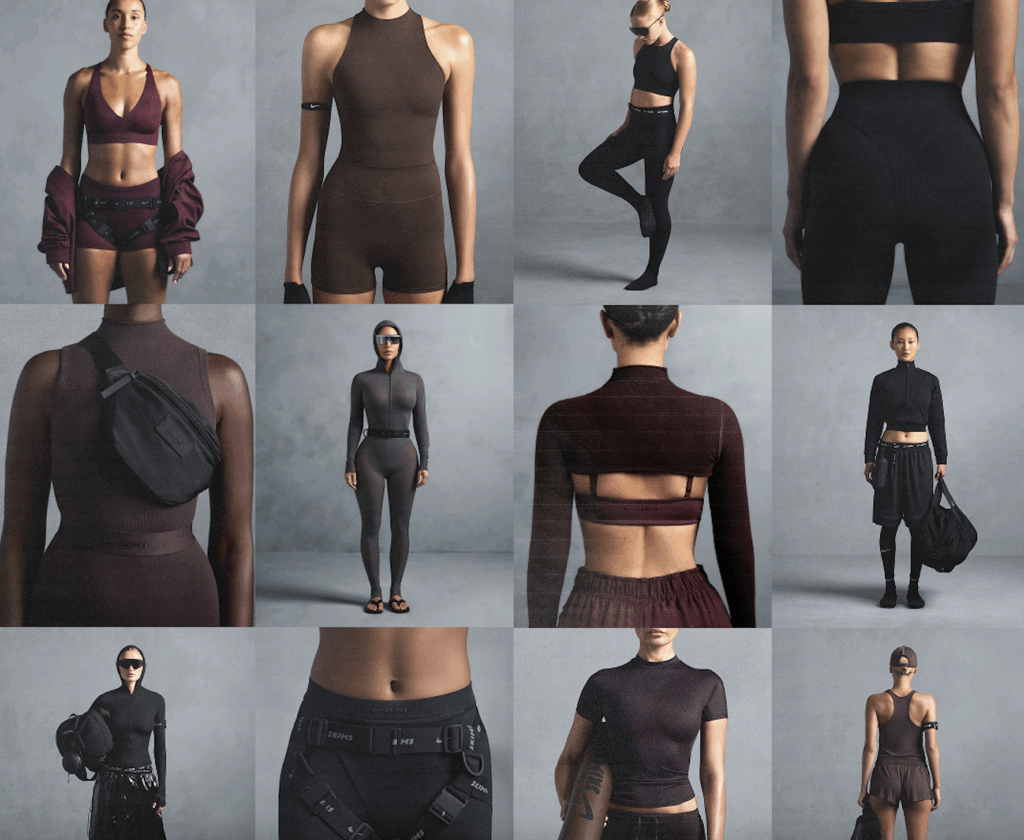
Nike has spent decades at the top of the sportswear hierarchy, while Kim Kardashians’ SKIMS has, in just a few short years, carved out a cultural stronghold with its focus on sculpted silhouettes and inclusivity across sizes. Together, the two are launching NikeSKIMS with a clear pitch: To deliver what they claim that no other label currently can, “a new aesthetic and system of dress, obsessively crafted for the body, that goes from the studio to the gym and beyond.”
This is not about selling leggings and sports bras under an amalgamated logo with a celebrity endorser; from the language being put further by Nike and SKIMS, it is about creating an entire category proposition, one that merges Nike’s technical mastery in performance wear with SKIMS’ intimate knowledge of fit and cultural relevance.

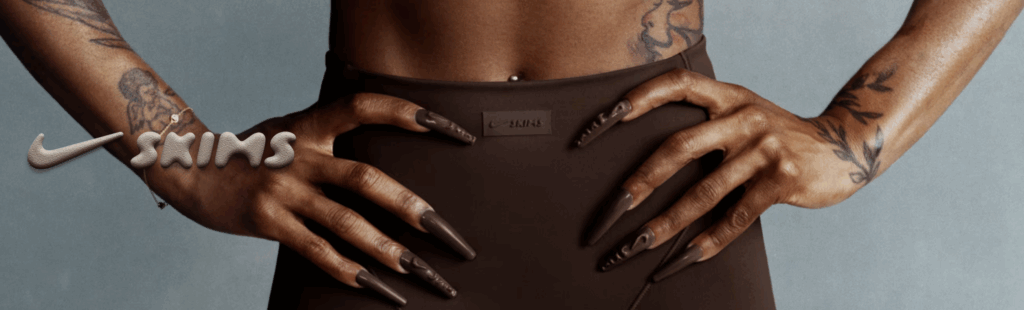
For Nike, the stakes are high. After several years of uneven performance in its women’s business, the company is betting that NikeSKIMS can do what its own core collections have not: capture the imagination of consumers who demand both function and fashion. For SKIMS, the partnership represents a once-in-a-generation leap, a chance to evolve from shapewear disruptor to global sportswear contender almost overnight. Together, the two are testing a model that may reshape the way global brands build sub-brands – not as slow, incremental extensions, but as fully formed ventures engineered from day one for scale, longevity, and cultural impact.
The Making of the New Venture
Nike’s history of both collaborations and sub-brands runs deep – from tie-ups with Dior and Travis Scott to sub-brands like ACG, Jordan Brand, and Nike SB. Some media outlets have described NikeSKIMS as a sub-brand of Nike (citing insiders and organizational signals), but Nike’s own press materials and SKIMS’ interviews have not definitively used that term. Instead, their public framing uses more general language – “new brand” and “distinct offering,” something that is decidedly not a run-of-the-mill “collaboration.” SKIMS co-founder and CEO Jens Grede said as much in a statement this week, asserting that NikeSKIMS is “more than a collaboration – it’s a new brand redefining activewear.”
So, where does NikeSKIMS fall on the corporate spectrum from sub-brand (a separate division under the Nike umbrella) or joint venture (a separately entity created by the two companies) to licensing deal?

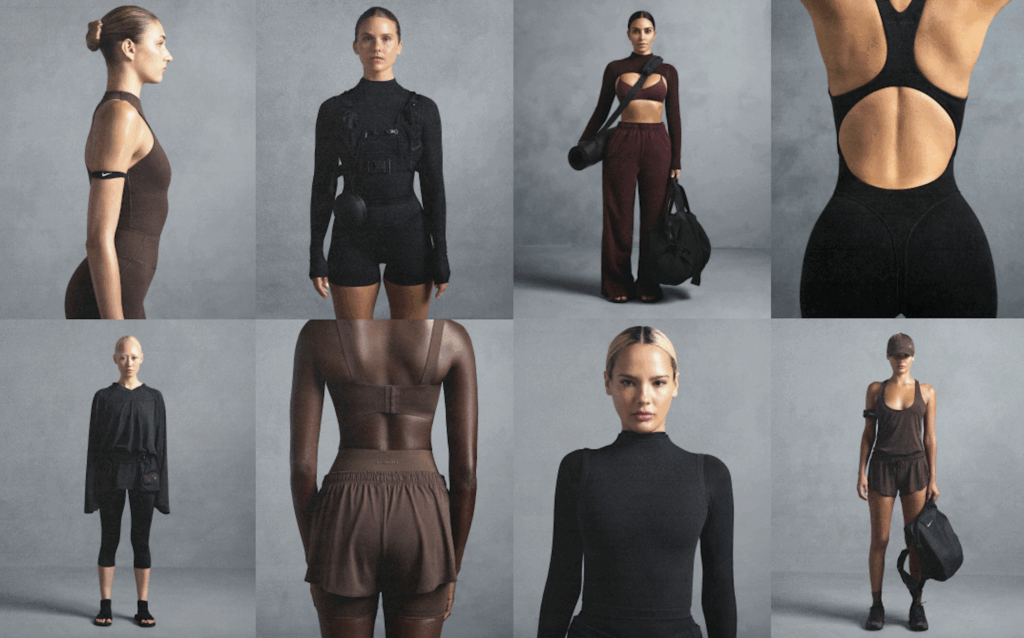
“Chances are, NikeSKIMS – which was described as ‘a long-term partnership’ in its initial February release – is structured as a licensing deal,” lawyer Kenneth Anand told TFL, making it a Nike-controlled venture designed to merge Nike’s resources and infrastructure with SKIMS’ brand equity.
As for what those Nike resources entail, talent is a big one, and manufacturing is, too. Fourteen-year Nike veteran Jordan Mills was tapped to lead operations at the division, and Jaclyn Safley, formerly Nike’s Global GM of Women’s Fitness and VP/GM of Nike Training, has stepped into the role of VP/GM of NikeSKIMS. Other Nike employees have been redeployed into core functions of the brand, spanning Retail Marketing, Global Brand Marketing, Digital Marketing, Product Design/Operations, Creative Direction, and Brand Operations.
The infusion of seasoned talent from Nike – and reports that the partnership will benefit from Nike’s product development and manufacturing capabilities, including performance fabrics and functional details like Dri-FIT technology – highlights the ambition behind the venture. The goal? To equip the new brand with the resources to scale globally while maintaining the technical credibility and design consistency expected of a performance-driven label. The fact that Nike is dedicating substantial in-house talent to work full-time alongside SKIMS executives Tracy Romulus and Paula Galperin on the NikeSKIMS venture is notable from this perspective but not necessarily a tell-tale indicator from a deal structure perspective.
If NikeSKIMS is a licensing deal, it is almost certainly one with “a lot of bells and whistles,” says Anand, who previously served as Head of Business Development and General Counsel at Yeezy, which maintained a similarly-structured licensing deal with adidas. “Since SKIMS has significant cultural cache as a brand and maintains its own retail network that will be used for distribution the collections,” which is relatively unique for celebrity partners, he states that such a licensing deal would likely come with lucrative terms for SKIMS.

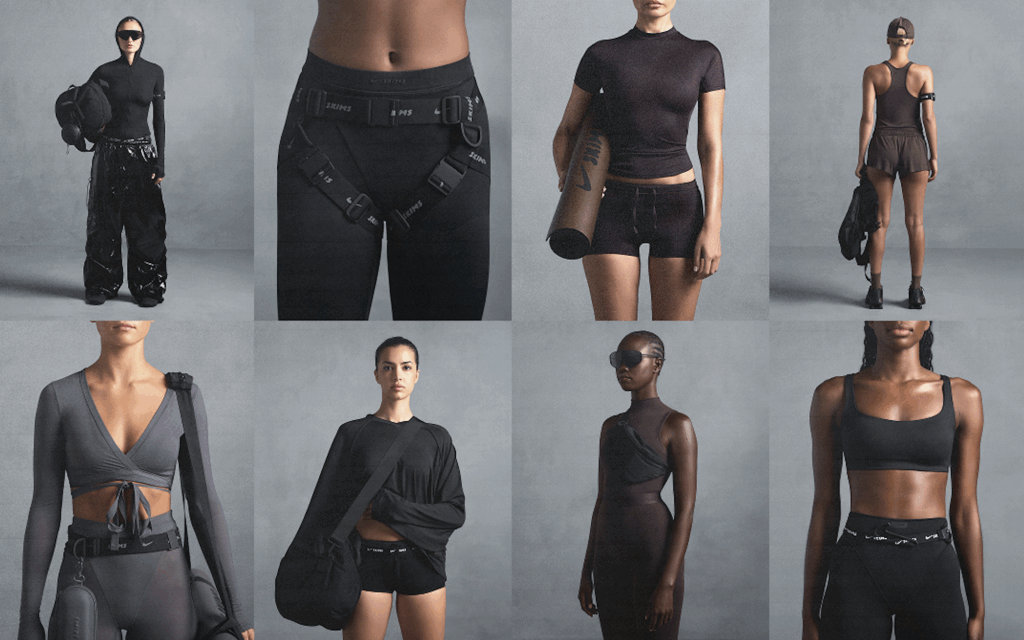
Specially-negotiated licensing terms aside, the provisions of a standard licensing deal would dictate that Nike owns all of the intellectual property that comes from NikeSKIMS, including new creative assets – like the brand’s debut film, Bodies at Work, trademark-protected names and logos, any product-related design patents, etc. (As of the time of publication, there were no public applications for registration for any NikeSKIMS marks; although, filings will undoubtedly follow.) It also means any co-branded items would need to be stripped of SKIMS marks in order to be sold by Nike in a post-deal-termination capacity.
From a financial standpoint, there is a similar opacity, as neither Nike nor SKIMS has disclosed revenue-sharing details. The precise compensation mechanics for SKIMS remain unknown, but possibilities in the realm of licensing include a royalty or revenue share (and in the event that it is a sub-brand entity, there might be an equity component for SKIMS).
THE BIGGER PICTURE: NikeSKIMS is more than an apparel line – it is a case study in how new global brands are being built at the intersection of fashion and sport. By pooling IP, resources, and distribution networks, Nike and SKIMS are attempting to build a billion-dollar women’s activewear brand virtually overnight.
The legal and business architecture will be closely watched. If NikeSKIMS proves successful, it may signal a shift in how established giants and emerging disruptors collaborate: not just through limited-edition capsules, but through full-scale brands that combine credibility and cultural capital in equal measure.
link